
Hotel wine glasses are working equipment, not only table decoration. They move through banquet setups, bar stations, dishwashing areas, storage racks and replacement orders. A glass that looks attractive in a sample room can become expensive if it chips easily, does not fit the washer rack, or cannot be matched when the hotel needs more units.
The right decision balances presentation, handling and long-term supply. There is no universal “commercial-grade” shape or dishwasher-cycle number for every hotel. Performance depends on design, production consistency, washing, chemicals, racks, handling and the buyer’s acceptance criteria. This guide turns those variables into a practical sourcing specification.

Start With the Hotel Service Scenario
Do not begin with a generic request for “durable wine glasses.” Define where each SKU will be used. A fine-dining restaurant may prioritize a refined rim and balanced stem. A banquet department may value fast rack loading, stable storage and easy replacement. A poolside or high-turnover venue may require a different risk assessment altogether.
Map each glass to an operating task
- Outlet and drink program: restaurant, bar, room service, banquet or event.
- Service volume: expected covers, peak events and table-reset frequency.
- Handling route: storage, trolley, service, collection, washing and return.
- Washing setup: rack dimensions, machine program, chemicals and drying method.
- Replacement need: local stock, central warehouse or imported replenishment.
This map prevents over-specifying a premium glass for every location or choosing one heavy design that does not suit the guest experience. It also gives the supplier a real basis for recommending models from its wholesale wine glass range.
Choose a Small, Functional Assortment
Every additional shape creates another item to purchase, store, count and replace. Many hotels can reduce complexity by using a versatile wine glass for several services, then adding a second wine or champagne shape where the beverage program justifies it. The correct assortment depends on the property, not on a fixed industry list.
Evaluate geometry before visual style
Record total height, maximum bowl diameter, rim diameter, foot diameter, capacity and weight range. Check whether the glass fits existing racks, shelves, trolleys and table layouts. A tall stem may look elegant but create clearance or balance problems. A broad bowl may reduce rack density. A wide foot may overlap neighboring positions.
Request a physical sample and run it through the actual service route. Staff should carry, rack, wash, dry, polish and store it. Procurement should then collect feedback on grip, balance, clearance and handling—not only appearance.
Understand What Durability Means
Durability is not one property. It includes resistance to impact during handling, thermal and chemical exposure during washing, stability during transport, and consistency across batches. A thicker or heavier glass is not automatically the most durable choice. Poor weight distribution, an unsuitable rim, residual stress or repeated glass-to-glass contact can still cause failure.
Inspect the main risk zones
- Rim: chips, roughness, uneven finishing and contact with nearby glasses.
- Bowl: thin areas, visible inclusions, scratches and impact points.
- Stem: straightness, proportion, joint quality and pressure during handling.
- Foot: flatness, stability, edge condition and rack contact.
The hotel should distinguish between a true defect and acceptable manufacturing variation. The agreed limits must be written around the selected product and production method. Machine-made stemware is often suitable when a hotel needs larger quantities, more repeatable dimensions and easier replenishment. Hand-blown production may be appropriate for a design-led, lower-volume program when the buyer accepts a different price and variation profile. Process follows the service, volume, budget and design requirements.
Treat Dishwasher Cycles as a Test Protocol, Not a Marketing Number
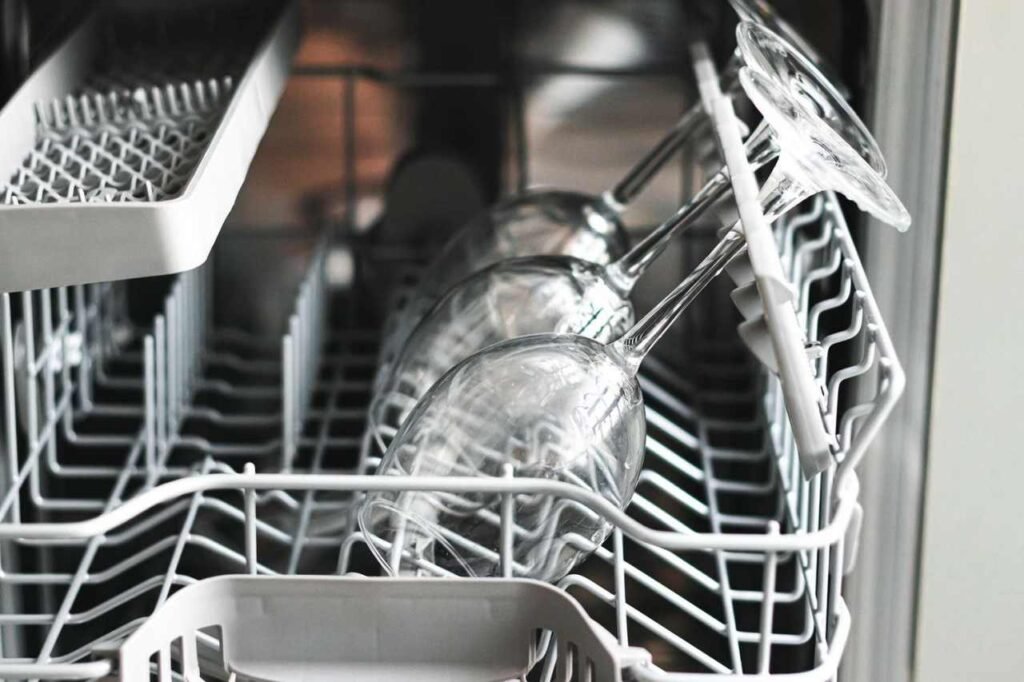
A claim such as “dishwasher safe” does not tell a hotel how the glass was tested. Commercial glasswashers can differ in program time, water temperature, spray pressure, detergent, rinse aid, water hardness, rack design and loading practice. Manual polishing and storage add further mechanical contact.
Define the cycle before asking for a cycle count
The buyer and supplier should document the intended washing conditions and what will be inspected after repeated cycles. Possible review points include cloudiness, surface change, rim condition, decoration adhesion and unexpected breakage. If a logo, color or metallic decoration is involved, test the decorated sample rather than assuming the result from a clear glass.
Separate glass performance from operating damage
Cloudiness may relate to deposits, water conditions or permanent surface change; the cause should be investigated rather than assigned automatically to the glass. Chipping can come from contact in the rack, collection bin or storage area. A useful trial therefore records the machine settings and follows the glass through the whole workflow.
Do not request an impressive cycle number without an agreed protocol. A smaller, well-documented test using the hotel’s conditions can be more useful than a large unsupported claim.
Run a Service Trial Before Full Rollout
Approve appearance and dimensions first, then place a controlled quantity into real hotel use. Mark or record the trial stock so it is not mixed with existing glassware. Train the participating team on the intended rack and storage method, because inconsistent handling makes the result difficult to interpret.
Record evidence that procurement can use
- Starting quantity and date placed into service.
- Outlet, washing program and storage location.
- Breakage location: service, collection, washing, polishing or storage.
- Failure type: rim chip, bowl crack, stem break, foot damage or surface issue.
- Remaining usable quantity at each review point.
The trial does not need to produce an absolute lifetime promise. It should reveal whether the model works with the property’s actual equipment and behavior, and whether changes to the glass, rack, handling or storage are needed.
Calculate Replacement Cost, Not Only Purchase Price
A lower unit price can be offset by frequent loss, emergency freight, mismatched replacement stock or excessive inventory. Compare the landed cost per unit, observed loss rate, labor involved in handling, required safety stock and the supplier’s ability to repeat the specification.
Use a simple replacement metric
For a defined period, track units removed from service divided by the units in service. Keep the reason codes separate. A glass broken by a trolley collision should not be analyzed in the same way as repeated rim chipping in a washer rack. This turns a vague complaint into evidence that operations and procurement can act on.
Also calculate the cost of being out of stock. If the original shape is unavailable, the hotel may need to mix profiles on the same table or replace an entire outlet assortment. Continuity can therefore be more valuable than a small difference in initial price.
Specify Repeat-Order Controls
Before the first order, ask how the model, mold, dimensions and approved sample will be identified for reorders. Keep the product code, drawing, capacity, weight range, packaging configuration and decoration reference in the purchasing file. Confirm whether future production will use the same process and how any change will be communicated.
Build a replenishment plan around lead time
Set a reorder point using actual consumption, observed breakage, planned events, supplier production time and shipping time. A new hotel opening may need more buffer than a stable property with established data. Avoid copying a fixed safety-stock percentage from another project.
DM Glassware’s manufacturing and quality-control capabilities are summarized on the Why DM page. Buyers should still confirm the exact production route, inspection scope and repeat-order controls for the selected SKU.
Make Packaging Part of Hotel Durability
Damage before the glass reaches the hotel is also a replacement cost. Review the retail or bulk pack, dividers, master carton, pallet method and unloading route. The bowl, stem and foot should be protected from contact and harmful pressure. Packaging must be validated for the chosen model and route rather than accepted as a generic “export carton.”
On arrival, record carton condition and inspect a defined sample before stock is distributed across the property. Clear receiving records help separate transit damage from later operational breakage.
Hotel Wine Glass RFQ Checklist
Send the following information when requesting a quotation or sample:
- Hotel type, outlets and beverage service scenario.
- Preferred capacity, dimensions, weight feel and visual direction.
- Estimated initial quantity and expected replenishment pattern.
- Rack dimensions, glasswasher program and relevant chemicals.
- Logo or decoration requirements and required wash evaluation.
- Inspection points, acceptable variation and sample approval process.
- Packaging, palletization, destination and receiving conditions.
- Required documentation for the destination market and intended use.
DM Glassware can review these inputs against available wine-glass models and production options. Contact the team with your service scenario and sample requirements instead of asking only for the lowest unit price.

Frequently Asked Questions
Are heavier wine glasses always better for hotels?
No. Weight can influence handling and perception, but durability also depends on geometry, weight distribution, stress, rim design and the hotel workflow. Compare samples in real service rather than selecting by weight alone.
How many dishwasher cycles should a hotel wine glass survive?
There is no meaningful universal number without a defined test method. Specify the machine program, chemicals, rack, loading method, inspection points and acceptance criteria, then evaluate representative samples.
Should hotels choose machine-made or hand-blown wine glasses?
Choose according to quantity, budget, design, dimensional consistency and replacement needs. Machine-made glasses are often practical for standardized, repeat-volume programs; hand-blown glasses may suit lower-volume premium concepts that accept their cost and variation profile.
How can a hotel avoid mismatched replacement glasses?
Keep an approved sample and specification, use a stable product code, confirm the production route, forecast consumption and place replenishment orders before safety stock is exhausted. Ask the supplier to communicate changes before producing a repeat order.
Source for the Full Service Life
The best commercial wine glass is not simply the cheapest or thickest. It is the model that fits the hotel’s service, washing equipment, storage, presentation standard and replacement system. Test it under real conditions, record breakage by cause and protect the approved specification for future orders.
Explore DM Glassware’s wholesale wine glasses or contact DM Glassware with your rack dimensions, service scenario, expected quantities and replacement plan to discuss suitable options.