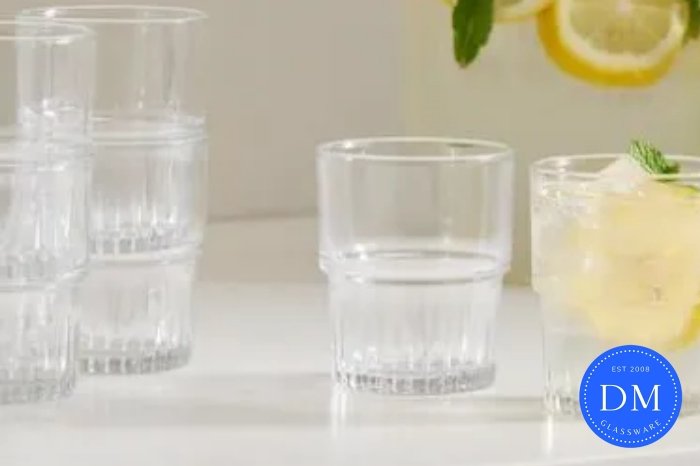
Stackable drinking glasses can reduce storage space and speed up service, but only when the glass is designed and tested for stacking. Placing one ordinary tumbler inside another does not make it a commercial stackable glass. Poor geometry can create rim-to-wall contact, wedging, unstable piles, trapped water, and sudden breakage during separation.
Restaurant buyers should treat stackability as a functional product requirement. The specification must connect the glass profile, contact points, stack height, operator handling, washing system, storage layout, and packaging. Price and appearance still matter, but a glass that fails in the real workflow creates more labor and replacement cost.
Buyers can review DM Glassware’s drinking glass collection to identify suitable product families. This guide explains what to check before approving stackable drinking glasses wholesale for restaurants and catering groups.
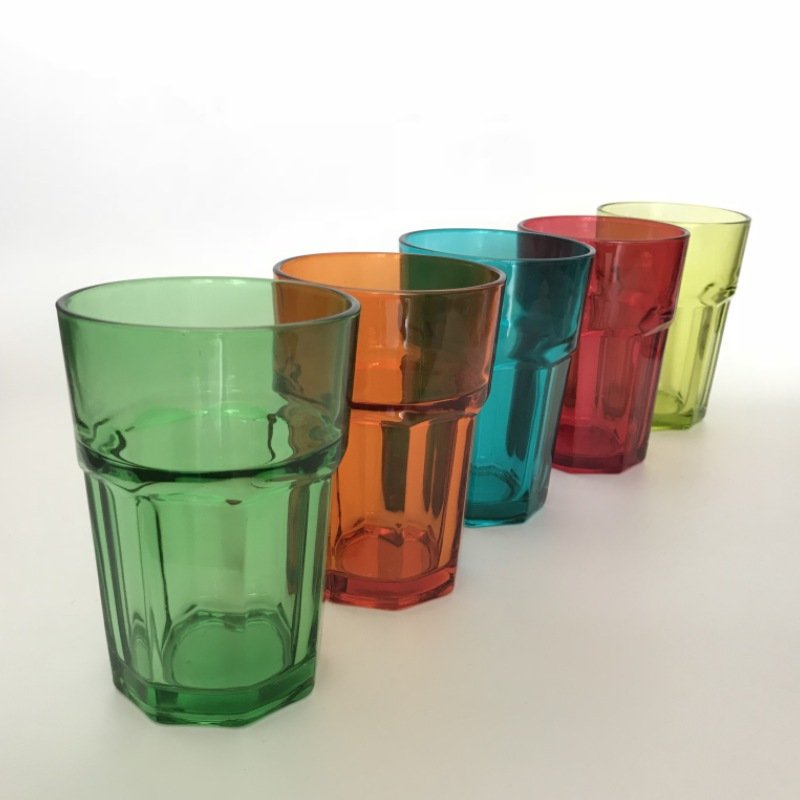
Image source: DM Glassware colored drinking glass collection
Define What “Stackable” Means for the Restaurant
Different buyers use the word differently. Before asking for samples, define the actual operation:
- How many glasses will staff stack at one time?
- Will the stack sit on an open shelf, under a counter, in a rack, or on a service trolley?
- Are glasses stacked dry, immediately after washing, or during table clearing?
- Will staff carry a stack by hand?
- What shelf height and footprint are available?
- What drinks, ice, garnish, and portion sizes must the glass support?
A product that stacks safely three high on a shelf may not be appropriate for a tall stack carried through a busy restaurant. The supplier needs the use case, not only the word “stackable.”
Understand the Stack Geometry
Purpose-designed stackable glasses normally use a profile that creates a controlled stopping point. The upper glass should rest on a designed shoulder, step, reinforcement zone, or other stable area instead of allowing its rim or lower wall to press unpredictably against the glass below.
Key geometry includes:
- body taper;
- location and width of the stacking shoulder;
- clearance between nested walls;
- rim diameter and rim strength;
- base diameter and center of gravity;
- vertical distance added by each glass; and
- release angle when one glass is removed.
The correct relationship must be checked with real samples. A drawing can show intended contact points, but production variation and surface friction affect actual stacking.
Avoid Rim-to-Wall Loading
If the upper glass stops because its rim contacts the wall of the lower glass, local stress may build at a vulnerable edge. If two tapered walls bind together, staff may twist or pull harder, increasing breakage risk. Ask the supplier to identify the designed contact zone and demonstrate how the glasses separate.
Measure Stack Height
Record the height of one glass and the total height of a defined stack. The difference between each additional glass shows the stacking increment. This helps restaurant buyers calculate shelf capacity and decide whether the space saving is meaningful.
Balance Stackability With Drinking Performance
A pronounced shoulder may improve stacking but affect appearance, cleaning, mouthfeel, or how the drink is presented. A very heavy base may feel stable as a single glass but make a tall stack harder to carry.
Review the complete product:
| Requirement | Buyer question | Sample check |
|---|---|---|
| Capacity | Does it support the menu pour, ice, and garnish? | Fill to actual service level |
| Grip | Can wet hands hold and separate it securely? | Test with service staff |
| Stack | Are contact points stable and repeatable? | Stack and separate the agreed quantity |
| Rim | Is the rim comfortable and protected from unwanted contact? | Inspect after repeated handling |
| Base | Does one glass and a full stack remain stable? | Check on shelf, tray, and counter |
| Cleaning | Does water drain and soil release from the shoulder? | Run through the intended wash process |
No single design maximizes every requirement. The approved product should balance the restaurant’s menu, workflow, storage, and budget.
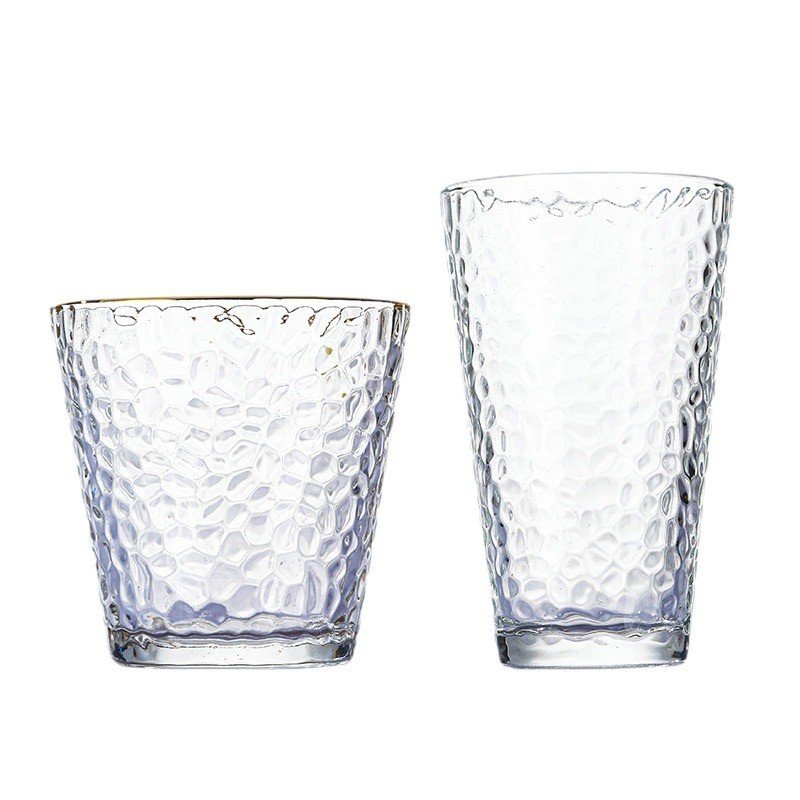
Image source: DM Glassware drinking glass and tumbler collection
Check Commercial Washing and Drying
“Dishwasher safe” is too general for a restaurant sourcing specification. Commercial washers vary in rack layout, cycle conditions, chemicals, water quality, and handling. Define the intended system and agree the evaluation method.
During sample review, check:
- whether the glass fits the intended rack opening;
- whether spray reaches the inside and stacking shoulder;
- whether water collects in a step or base feature;
- whether glasses drain and dry before stacking;
- whether the rim or body contacts the rack incorrectly; and
- whether decoration changes after the agreed wash evaluation.
Do not stack glasses while water or debris remains between them. Moisture can increase friction, create hygiene problems, or make separation unpredictable. Restaurant procedures should include adequate draining and visual checks.
Food-contact suitability, stackability, thermal response, and decoration durability are separate questions. A report addressing one does not automatically prove the others.
Specify Rim, Wall, and Base Quality
Stackable glasses experience repeated contact during washing, storage, and separation. Buyers should define inspection points without making unsupported promises such as “chip-proof” or “unbreakable.”
Rim
Check smoothness, finish, roundness, and whether the designed stack keeps load away from the rim. Define how chips, cracks, sharp edges, and unacceptable deformation will be classified.
Body and Shoulder
Inspect the stacking feature for consistency, visible distortion, mold marks, and changes that affect contact. Measure the feature at agreed points if it is critical to function.
Base
Check stability, rocking, glass distribution, and whether the base creates excessive weight in a full stack. A decorative heavy base may be useful for one service style but unsuitable for rapid stacked handling.
Machine-made production is often considered for repeat commercial volumes because the process can support controlled dimensions. However, process choice must follow the approved product, quantity, MOQ, tooling, design, and cost. Machine-made does not remove the need for functional stack testing.
Test With Restaurant Staff, Not Only Procurement
Procurement can approve price and specification, but servers, bartenders, dishwashing staff, and store-room teams understand the workflow. Give them production-representative samples and a short test plan.
Ask them to perform:
- loading and unloading the wash rack;
- stacking the agreed number of dry glasses;
- carrying and placing the stack as normally required;
- separating glasses with dry and slightly wet hands;
- placing glasses on actual shelves and trays; and
- serving the intended drinks with ice and garnish.
Record problems, not only preferences. Wedging, wobble, difficult grip, slow drying, rack interference, and unstable carrying are actionable findings.
Approve a Stackability Sample Standard
The approved sample and specification should define:
- product drawing and revision;
- nominal capacity and key dimensions;
- the designed contact point;
- agreed number of glasses per functional stack test;
- total stack height and stability requirement;
- separation method;
- washing and drying procedure used for approval;
- appearance and defect criteria; and
- pack count and carton identification.
If the mold, weight, profile, coating, or relevant process changes, review whether the stackability approval must be repeated. A visually small shoulder change can affect how the whole stack behaves.

Image source: DM Glassware quality-control overview
Plan Packaging and Delivery
Stackable in use does not always mean nested for international shipping. Nested transport can create rubbing, wedging, or concentrated impact unless the packaging is specifically designed and validated for it.
Confirm:
- whether glasses ship upright, inverted, or nested;
- divider and cushioning locations;
- inner-pack and master-carton quantities;
- protection for the rim and stacking shoulder;
- carton gross weight and warehouse handling; and
- pallet pattern and carton identification.
Evaluate the fully packed carton using the buyer’s agreed handling or transport protocol. Do not assume that space-efficient restaurant storage automatically creates the best export pack.
Calculate Operational Value
The lowest unit price may not produce the lowest operating cost. Compare:
- shelf space used per service quantity;
- number of glasses carried per trip;
- time required to stack and separate;
- wash-rack utilization;
- breakage and discard records;
- replacement availability; and
- carton and delivery efficiency.
Use a trial in the actual venue where possible. Operational data from staff can justify a slightly different design or pack format better than a catalogue comparison.
Restaurant Buyer Checklist
Before placing the order:
- define the venue, drink, and stack use case;
- confirm capacity, dimensions, and rack fit;
- identify the designed contact point;
- approve stack quantity, height, stability, and release;
- test washing, drainage, drying, and handling;
- set rim, body, shoulder, and base inspection criteria;
- validate the export packaging approach;
- confirm repeat-order specifications and change notification; and
- keep an approved reference sample.
Frequently Asked Questions
Can any tapered tumbler be stacked?
No. A tapered wall may allow nesting, but safe functional stacking requires controlled contact, clearance, stability, and separation. Test the exact production sample.
How many glasses should restaurants stack?
There is no universal number. Define a maximum based on the product design, shelf, carrying method, staff workflow, and supplier-approved test. More is not automatically better.
Are stackable glasses stronger than regular glasses?
Stackability describes a design function, not a general strength guarantee. Durability depends on the full design, glass distribution, manufacturing, handling, washing, and inspection.
Can stackable glasses be shipped nested?
Only when the packaging design and agreed transport evaluation support it. Restaurant stacking and export shipping create different forces.
Source Stackable Glasses Around the Workflow
The right stackable restaurant glass is designed around controlled contact points and verified in the real operation. Buyers should approve not only appearance and price, but also rack fit, drainage, stack height, stability, separation, staff handling, packaging, and repeat supply.
Restaurants, catering groups, and hospitality distributors can contact DM Glassware with the target capacity, reference design, stack quantity, rack dimensions, pack format, destination, and expected volume. DM can review suitable product and production options before sampling.